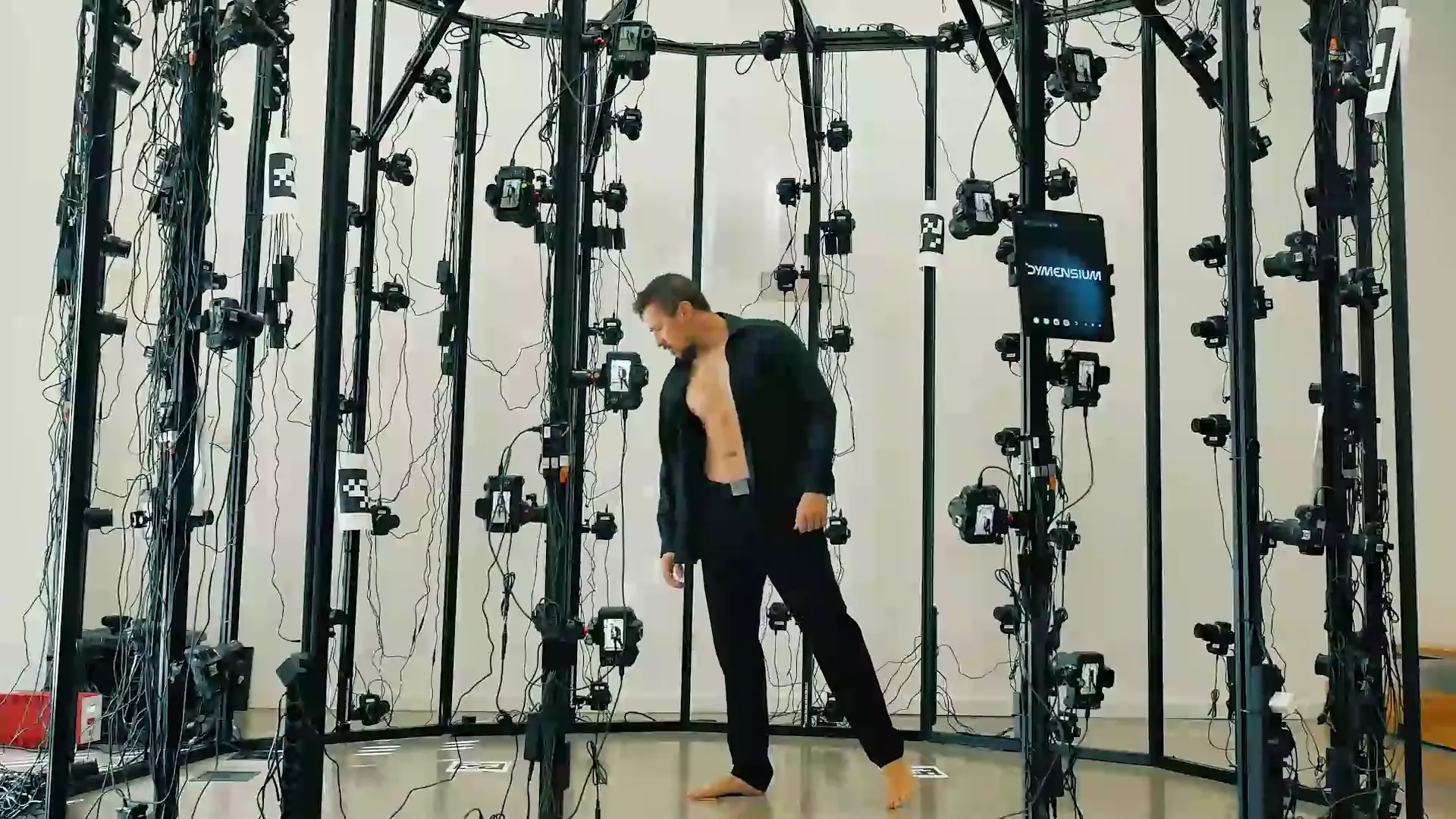
Volumetric capture and volumetric video
Volumetric capture records the full volume of what is filmed, not a flat image. With a still subject, the result is a 3D model. With a subject in motion, it is a sequence over time: volumetric video.
The difference with regular video is the camera. In volumetric video, the viewpoint is chosen at playback, not at recording.
How it works
- 01A rig of synchronized cameras surrounds the capture volume and records at the same time.
- 02Software works out the exact position of each camera and combines their images.
- 03With that information the subject is reconstructed in 3D, instant by instant if there is motion.
- 04The result is optimized for the platform where it will be seen: the web, virtual or augmented reality, 3D engines or post-production.
How the volume is represented
A capture can be stored in several ways. These are the most common:
- Textured meshes
- The traditional approach: every instant becomes a polygon surface with an image on top. It fits classic 3D pipelines but simplifies hair, clothing and transparency.
- Point clouds
- Millions of colored points. They are easy to generate, but up close they show gaps and hard edges.
- Gaussian Splatting
- Millions of semi-transparent Gaussians fitted to the images. It keeps fine detail and a real look, and plays back in real time. It is the technique we work with at Dymensium.
Why Gaussian Splatting
It keeps what makes a recorded person believable better than meshes do: hair, the texture of clothing, soft edges and highlights.
The same technique covers still subjects (3D Gaussian Splatting) and motion (4D Gaussian Splatting), and it plays back in real time on the web, on virtual reality headsets and in engines such as Unreal Engine or Unity.
If a project also needs a mesh, for physics simulation or 3D printing for example, it can be combined with photogrammetry.
How it differs from 360 video and motion capture
- 360 video
- Records from a single point. The viewer can turn their head but cannot move through the scene.
- Motion capture
- Records the movement of the skeleton to animate a digital character. It does not record what the person actually looks like; volumetric capture does.
What it is used for
- Film, VFX and virtual production: real performers and scenes with a free camera.
- Advertising and fashion: people and garments in motion for campaigns and brand experiences.
- Sports: motion analysis and volumetric replays.
- Virtual and augmented reality, and video games: real people inside interactive experiences.
- Heritage, museums, education and science: digital preservation and visualization.
How to choose a volumetric capture studio
Before commissioning a capture, it is worth asking:
- Which technique it uses to reconstruct: meshes or Gaussian Splatting. It sets how realistic the result is.
- How many cameras the rig has and whether they are synchronized. More viewpoints give a more complete reconstruction.
- Which formats it delivers and whether it adapts them to your platform: web, virtual reality, Unreal or Unity.
- Whether it helps with integration and gives technical support after delivery.
- Whether it can show you real captures made in its own studio.